The main thing about narcissistic abuse is that there are so many ways you can be abused, without it actually looking like abuse. That's why so many people don't realize what's happening to them until it's too late.
I have 9 everyday ways a narcissist can hurt you, and they cover their tracks so you don't call abuse in their name. Once you know what they are, you'll realize quite how fooled the narcissist had you over time.
And here's what stings the most. You'll look back and see all the moments you brushed off, thinking you were overreacting. You weren't. You were being trained not to notice.
Figuring out what abuse is
Often I hear people say that if it didn't involve a direct insult, or a punch or a kick, then it isn't abuse. How wrong they are.
I wish I could sit them all down and go through every aspect of narcissistic abuse, and then they'd know just how bad it can get, and how hurt victims of it can be. Have you been a victim of narcissistic abuse?
Maybe it's something you're going through already, and if it is, you've come to the right place. Joining the dots of your abuse often means you notice or admit things that you've tried to convince yourself were nothing.
If it doesn't look dramatic, that doesn't mean it isn't abuse, and no narcissist is going to want to be that obvious because then they'd put their entire game of toxicity at risk.
In fact, some of the most effective ways they abuse is when they're most quiet; when they casually yet intentionally mean to do something mean…
…Even with a smile on their face. Figuring out what abuse is and all the different color masks it wears is worth your time, your sanity, and your future.
I had a client tell me once, "He never hit me, so I thought I was overreacting for years." That sentence has stayed with me. Quiet abuse still counts.
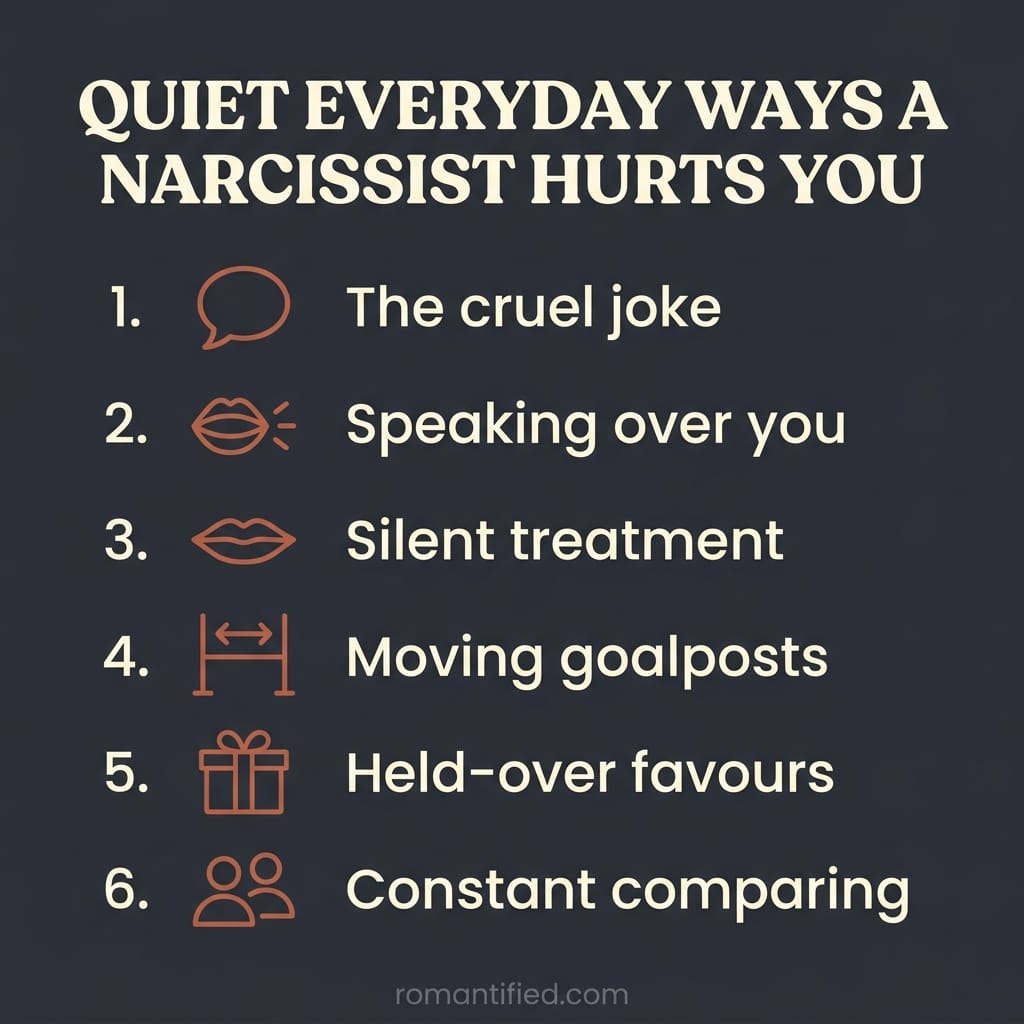
1The 'joke' that hurts
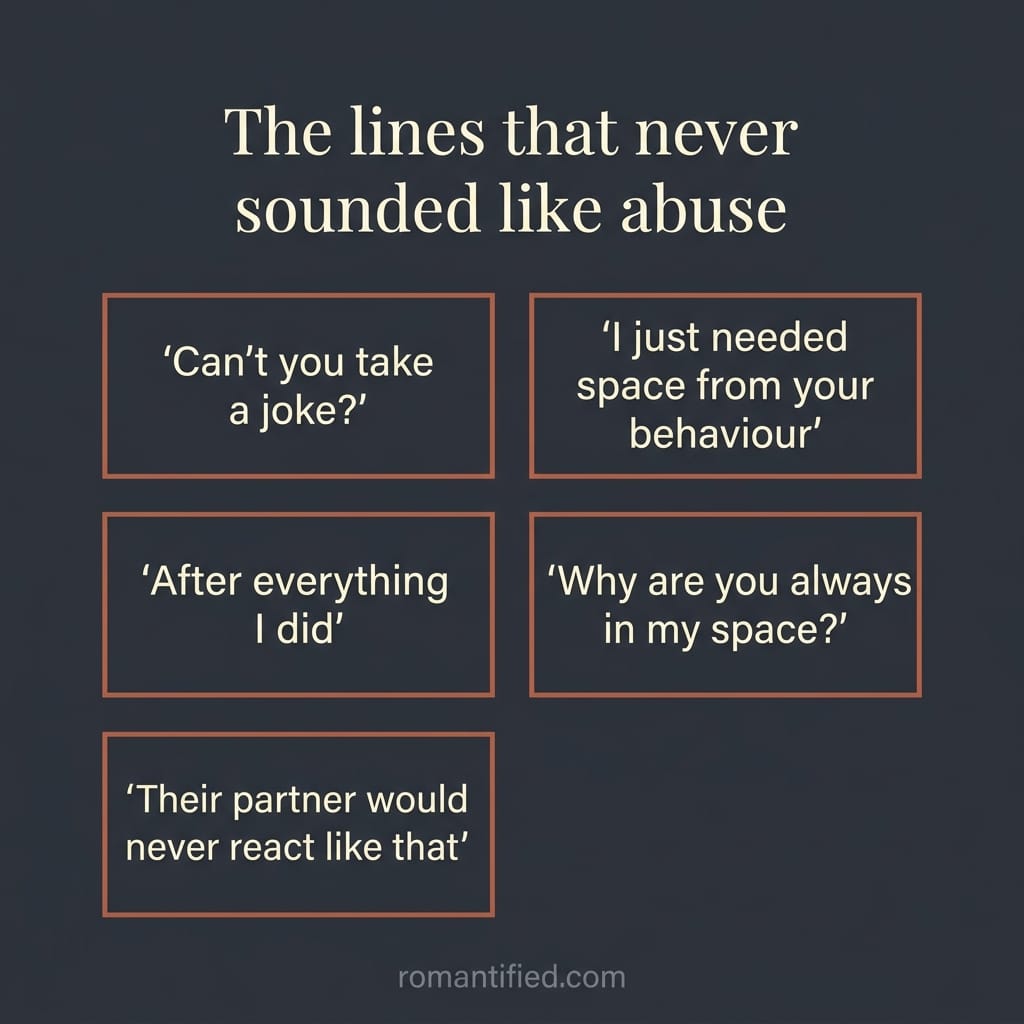
I cannot stress this enough, and you know, in my day to day I see it when I'm out, or around people I've known in my lifetime. The joke that isn't really a joke. Come on, learn to take a joke. I was just messing with you.
Stop being so sensitive. Why are you always so serious? You're not sensitive; you're responding to a hurtful comment that was delivered as though it had some kind of punchline attached to it.
First off, the narcissist will insult you, but they will deliver it in a way that makes it seem as though they're on stage, trying to make everyone else laugh. When you don't laugh, the blame will be handed directly to you. You didn't take it; you didn't laugh either.
The narcissist knew you'd never laugh, but they wanted you to prove yourself in that moment. Here's the thing:
 See alsoNarcissists End the Relationship but Refuse to Let You Go, and Here's Why
The joke? It was never the point. The point was to hurt you and make you feel like you were being swallowed up whole by the ground.
And then they scan the room, waiting for someone to back them up. Someone usually does, with a little chuckle. That chuckle sits with you for days.
2Speaking for you
I hate this part about narcissistic abuse because it can go unnoticed for years. When a narcissist cuts into what you're saying and speaks for you, or they finish your sentence, it's not sweet, and it isn't that they know you so well.
It's because they love to use their voice, and they want it to be heard over yours. Finishing your sentence can sometimes mean they get to end it their way, in their words, rather than listen to you.
It's not nice to have this happen to you, but it's hurtful for the person who is trying to speak. Over time, you likely learn that your voice doesn't matter, so you speak less. You stop talking first and learn to blend into the background.
One client told me she went almost a whole dinner without saying a word, and her husband still answered questions the hostess asked her directly. Sound familiar?
 See also5 Passive Aggressive Tactics Narcissists Use That You'd Never Recognize As Abuse
This is precisely what the narcissist wants.
3The post 'you upset me' silent treatment
Narcissists really show their cruel side when they show just how silent they can be post anything you've done to upset them. And it doesn't even have to be anything actually upsetting, it's just what they deem to be so.
They're absent, cold and there's no explanation as to why the sudden change of emotions temperature, and it's all because they use silence as a power over you. They know it bothers you, and that you eventually go chasing after them wondering what you did wrong.
You ask, but get nothing, and that is a purposeful way to make you feel uncomfortable. The usual outcome is you apologizing for everything you haven't done wrong, which is wildly unfair.
And when they finally speak? It's some cold little line like, "I just needed space from your behaviour." No detail. No accountability. Just enough to keep you spinning.
4The constant goalposts moving
Hurtful to say the least. Nothing you do will be right, nor good enough for the narcissist. The amount of times victims find themselves changing their behavior or adjusting the way they approach the narcissist. They try hard, they do as they're told, and even that is never enough.
This isn't because you're not good enough, but because the narcissist changes rules and moves goalposts so you never meet their needs. They will always find a way to be unhappy, and in addition, make you the reason why that is.
You won't win, even if you follow their specific rules. Sad as it is, winning was never available to you because their moving goalposts meant you were spending every day chasing their approval and for what?
 See alsoSay Yes To Just One Of These 6 Things... And The Narcissist Wins
One week they want you home early, the next they're sneering, "Why are you always in my space?" You can't win a game where the rules keep flipping.
To be told yet again that you're a letdown. Plus… you're always kept under their control.
5"Remember that favor?"
Oh boy, you'd better recall, because narcissists aren't giving, kind people unless there's something in for them at a later date. This usually manifests during future arguments, where the narcissist will remember that one time they did something mildly nice, and they will hold it against you. After everything I did.
I put you first all the time, and this is how you repay me. I sacrificed so much to make you happy. There shouldn't be any receipts where kindness is involved, yet there is always a condition attached to the narcissists.
They want you to remember what a good person they were that one time for ten seconds so they can cash in on it.
One client told me her ex brought up a birthday dinner from four years ago every single fight. Four years. That dinner was working overtime, wasn't it?

6Checking in or keeping tabs?
Where are you? How long will you be? Why aren't you answering your phone? Who are you with? Questions fired out one after one, and of course, if delivered the right way in the right tone, they can each seem caring, right?
It's as if they really love you and want to support you, but this couldn't be further from the truth. Caring doesn't look like monitoring, and that's what you need to remember every time you end up feeling trapped trying to do something.
If your plans change to ease these questions, then you already know what's going on, you just need to admit it to yourself.
I had someone tell me once she started lying about coffee dates just to avoid the interrogation. That's not a relationship, that's a curfew with a wedding ring.
7The backhanded compliment that stings
Compliments that end up leaving a negative mark on you are not compliments. You scrub up well. That was actually pretty clever for you. I didn't think you were this smart if I'm honest. You smile, but it doesn't quite seem right. That's because these aren't compliments at all.
Instead, they are all attempts to chip away at your self-esteem until there's nothing left, and just like the rest, is very damaging to you.
And when you flinch, they go, "Wow, can't you take a joke?" So now you're the difficult one for noticing. Clever little trap, that one.
8The Guilt Trip Wrapped in a Sigh
You ask them if everything is okay, and out comes the sigh. Long. Weighted. The kind that fills the whole kitchen.
 See also7 Weaknesses Every Narcissist Has That Will Destroy Them In The End
"No, no, it's fine. I'm fine."
But it isn't fine, is it? You know it, they know it, and now you're the one scrambling to figure out what you did, what you didn't do, what you should have done differently. They haven't said a single accusatory word. They don't need to.
The sigh did all the work.
I had a woman tell me she used to feel her shoulders climb up to her ears the moment her partner walked through the door, just waiting to hear the exhale. That's guilt tripping in its quietest, sneakiest form.
No shouting, no accusations, just a soft, disappointed noise that makes you feel like you've failed some test you didn't know you were taking.
And when you finally ask what's wrong, you get the classic, "If you don't already know, I'm not going to tell you."
Cue three more hours of you trying to work it out.
9Comparing You to Everyone Else
You've heard it. Some version of, "Well, so-and-so's partner would never react like that," or, "My ex used to handle this so much better."
 See also5 Creepy Things Every Narcissist Hides Somewhere in Their House
It's designed to make you feel like you're constantly being measured against a scoreboard only they can see. And you're losing. Always.
Sometimes it's a sibling. Sometimes it's a coworker they barely know. Sometimes it's a total stranger they saw in a coffee shop. Doesn't matter who. The point is you fall short.
And the sneaky part? They rarely say anything outright cruel. It's always framed as an observation, a passing comment, a little something they noticed. So if you push back, you look like the one who's insecure.
But what it really does is chip away at how you see yourself. Slowly. Steadily. Until you start comparing yourself to those same people without even realising you're doing it.
That's not love. That's not a partner nudging you to grow. That's someone teaching you to feel small in a room they get to design.